The Coding Singularity Has Arrived
What happens when coding stops being scarce—and why everything outside code is still stuck in 2015.

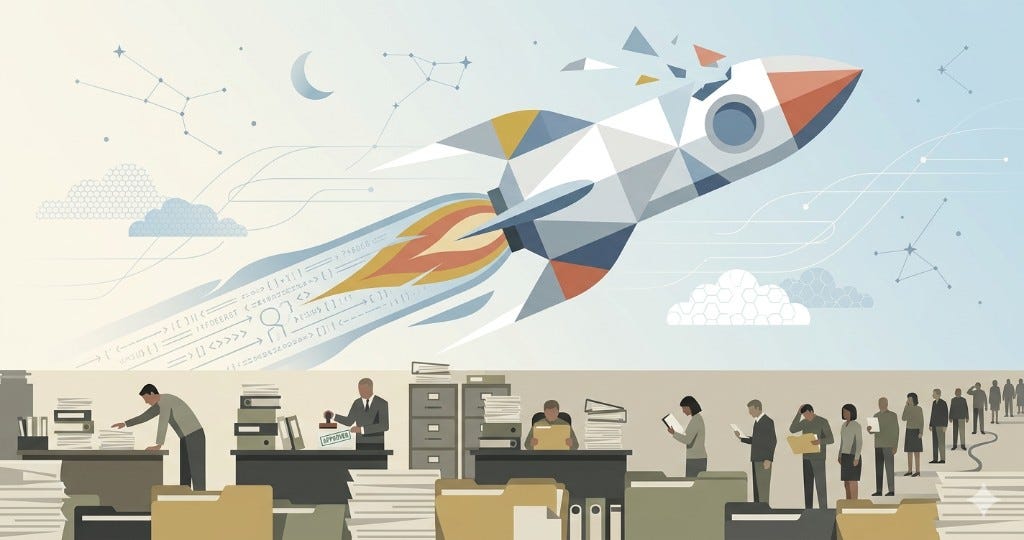
Something strange is happening in software.
We can now ask an AI agent to implement a feature in minutes.
Ship multiple builds in a single day.
But submitting that build to Apple for signing still takes an hour.
Code has taken off like a rocket.
Everything around it is still crawling on the ground.
The reason is simple:
Coding has crossed a singularity.
Recently a tool called OpenClaw went viral among developers for enabling agent-driven coding workflows. But if all you see is OpenClaw, you’re missing the real story.
OpenClaw is not the story.
It is a signal.
A signal that something fundamental has changed in how software is created.
Once you see that change clearly, a much deeper question appears:
What happens to the world when coding stops being scarce?
1. The Most Important Change of 2026
For decades, the software industry operated under one basic assumption:
Coding ability is scarce.
Code had to be written line by line.
Systems had to be built gradually by teams.
Engineering time was the most expensive resource in the company.
Entire organizations were designed around this constraint.
Product managers scheduled features.
Engineers estimated timelines.
Testing teams ensured stability.
One of the most important responsibilities of technical leadership was allocating limited engineering capacity.
But in 2026, that assumption collapsed.
Agentic coding crossed a critical threshold.
Coding used to be expensive, specialized, and scarce.
Now it is rapidly becoming something you can summon on demand.
What used to take 100 days to build can now be built in one day.
A 100× acceleration.
And a 100× perception gap.
This is not a prediction.
It is already happening.
Most people simply haven’t noticed yet — or don’t want to.
Maybe this is what the early days of AGI actually look like.
People see it and shrug:
What does that have to do with me?
2. When Supply Explodes, Creation Becomes Cheap
History shows a consistent pattern.
Whenever a scarce capability suddenly becomes abundant, the first result is not democratization.
It is supply explosion.
When the printing press appeared, books exploded in quantity.
When cloud computing arrived, software startups exploded.
Now that agentic coding has crossed the threshold, software supply will explode too.
In the past, building a product required:
capital
engineers
time
deep technical expertise
Those barriers are collapsing.
And once supply explodes, something strange happens:
Making things stops being valuable.
Many people react to this with excitement.
They imagine a world where entrepreneurship becomes easier, innovation flourishes, and creativity explodes.
But behind that optimism lies a harsher reality.
Supply explodes.
Demand does not.
There can be infinitely many books.
But human reading time does not increase.
There can be infinitely many apps.
But human attention does not expand.
If it’s easier for you to build something, it’s equally easier for everyone else.
Competition intensifies.
Copying becomes nearly free.
The time between invention and imitation shrinks toward zero.
What you build today can be replicated tomorrow.
Moats built on engineering complexity suddenly look much weaker than they once did.
So the real scarcity becomes something else:
Attention.
When supply explodes, building something stops being valuable.
Attention becomes the real bottleneck.
3. The Real Bottleneck Is Everything Outside Coding
If you observe how companies actually operate, you’ll notice something strange:
Everything outside coding is friction.
In the past, engineering was the slowest step.
So every other process queued behind it.
But now code production runs at 100× speed, while everything else remains at 1× speed:
requirement definition
design collaboration
review processes
project management
growth and distribution
The result is absurd.
Writing code is incredibly fast.
Projects themselves are not.
Agents can already do many things.
Organizations cannot use them effectively.
Engineering capacity is no longer the bottleneck.
Organizational friction is.
Many companies think they are undergoing “AI transformation.”
In reality, they have simply inserted AI into old workflows.
They celebrate meaningless metrics like:
“AI now writes 50% of our code.”
But everything else remains unchanged.
Requirements are the same.
Collaboration is the same.
Reporting structures are the same.
Acceptance processes are the same.
The organization itself is treated as sacred.
Everyone must adapt to the organization.
Even AI must adapt to the organization.
The most dangerous assumption today is this:
Our organization is fine. AI just isn’t powerful enough yet.
4. Should Everything Be Rebuilt With AI?
Here is an uncomfortable realization.
Not everything deserves to be rebuilt with AI.
Most things simply are not worth rebuilding.
It’s like witnessing the invention of the train and insisting on becoming a better horse-carriage driver.
Traditional software evolved under a basic constraint:
Software was expensive to build.
Because development was costly, software became standardized:
fixed interfaces
fixed features
fixed workflows
fixed roles
Users adapted themselves to the software.
But once coding supply becomes effectively infinite, this logic breaks.
Why should software still look the way it used to?
Why do we still install 100 apps on our phones and constantly jump between them?
The real opportunity is not making old software faster.
The real opportunity is redefining what software is.
Software could become:
capabilities generated on demand
systems organized around tasks instead of features
interfaces that adapt to context instead of forcing users to adapt
Most importantly, software may no longer be designed primarily for humans clicking buttons.
It may be designed for agents to understand, invoke, and integrate.
The biggest opportunities won’t come from rebuilding old products faster.
They will come from building software that could not exist before.
5. OpenClaw Is Not the Answer
To understand what’s happening, one framework helps:
Unbundle first. Then rebundle.
Whenever a core capability becomes cheap, integrated systems break apart.
Components that used to be bundled together separate.
New fragments appear.
Experimentation explodes.
That’s the phase we’re in now.
But fragmentation is never the end state.
Eventually, a new integration layer emerges.
Users cannot live forever in a fragmented world.
The more pieces exist, the more valuable recombination becomes.
OpenClaw is interesting not because of its features.
It is interesting because it represents rebundling.
Not just rebundling tools.
But rebundling entire workflows.
Why can one person suddenly do the work of ten?
Not because they gained a few new features.
But because a new workflow reorganized tasks that were previously spread across many people and processes.
OpenClaw may not be perfect.
But it signals something larger.
A transformation in how work itself is structured.
6. Work for Agents. Work with Agents.
Two ideas define the next phase of software.
Work for agents. Work with agents.
Work for agents describes a product strategy.
Future growth will not come primarily from traditional interfaces.
It will come from agents.
The key question will not be:
Will a human open your product?
Instead it becomes:
Will an agent discover it, understand it, and integrate it into a workflow?
Work with agents describes a production method.
Humans must learn to collaborate with agents as real teammates.
Not as chat assistants.
But as participants inside workflows.
Learning to:
delegate tasks
provide context
evaluate outputs
ship results together
One defines direction.
The other defines capability.
Both are required.
7. The Hardest Change Is People
In the end, the hardest thing to change isn’t software or organizations.
It’s people.
When transformation arrives, the first reaction is rarely excitement.
It’s confusion.
Suddenly the skills people spent years building start losing weight.
Experience feels less valuable.
Identity becomes uncertain.
Under that pressure, people instinctively try to work harder.
They repeat the past faster.
Because repetition feels safe.
But the real shift requires something else.
Not working harder within old roles.
But becoming a different kind of contributor.
Helping agents move faster.
Helping the entire system move faster.
The coordinate system of the world has changed.
Bring your agents with you.
And find your place again.
Conclusion
OpenClaw itself doesn’t really matter.
Using it or not using it doesn’t matter that much either.
What matters is recognizing this:
Everything outside coding is already outdated.
Once coding stops being scarce, the logic of the software world must be rewritten.
What becomes scarce in the future is no longer execution ability.
It is judgment.
Recombination.
Taste.
The ability to define entirely new kinds of software.
Code is cheap.
Show me your taste.
Basically, AI think for you. That process of pushing back — that's how you build good taste. It is smooth, but it also makes you stop thinking.
The lifecycle of evolution is such… I look forward to mental models adapting to this shift and enhancing the peripheral processes. And how cool is that we get to be a part of that change culture!
Looking forward to more of your reads!